




AI inventory management uses machine learning to predict demand, flag stock risks, and prepare replenishment before a human asks. Instead of someone eyeballing a spreadsheet every Monday, the system reads your sales history, seasonality, and supplier lead times, then tells you what will run out, what is overstocked, and what to reorder now. The good news for mid-size companies: you no longer need enterprise software budgets to get it. If you run a modern ERP, most of this capability is a configuration and discipline problem, not a purchase.
We implement inventory systems for wholesalers, manufacturers, and multi-channel sellers, so this guide covers what actually works in production, what is marketing, and the practical path to getting it into the system you already run.
What AI inventory management actually does
Vendors sell these capabilities as inventory intelligence, AI inventory optimization, or AI inventory management software. Under every label, it is the same six jobs:
Demand forecasting. Models read your own sales history plus seasonality and trends, and project demand per product. The practical difference from a static reorder point: AI inventory forecasting moves when your business moves, so a product heading into its strong season gets ordered earlier without anyone remembering to do it. Retailers feel this hardest around promotions; parts and maintenance operations feel it in slow-moving spares that suddenly are not.
Stockout prediction. Forecast plus supplier lead time equals a date. When the math says an item runs out before the next purchase order can land, the system flags it while there is still time to act. This single mechanism prevents more lost revenue than any dashboard.
Reorder drafting. The next step past alerts: the system prepares the purchase order, quantities and vendor included, and a human approves it. Buying stops being data entry and becomes review.
Overstock and dead-stock detection. The same models work in reverse, surfacing items whose demand has fallen away so capital stops sitting on shelves. Slow movers get flagged for promotion or discontinuation instead of being discovered at year-end counting.
Count-drift and anomaly flags. Duplicate SKUs, negative stock, records that jump in ways real goods cannot: AI is good at noticing what does not fit the pattern, which is usually where shrinkage and process breaks hide.
Plain-language answers. The newest layer: asking “which products will run out before their next PO lands?” in a chat window and getting the answer from live data. We cover this pattern in our ERP AI chatbot guide.
AI in warehouse management: the physical half
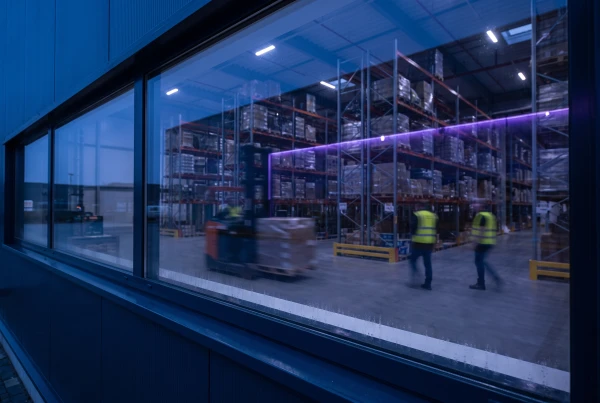
Inventory intelligence is only as good as what actually happens on the floor, and AI now works that side too. Barcode scanning and computer-vision counting keep on-hand numbers honest without shutting the warehouse down. IoT sensors feed real-time location and condition data, which matters most for cold chains and regulated goods. Picking and putaway routes get optimized against how orders actually flow, and cycle counts get scheduled by velocity, so your fastest-moving items get counted most often. None of it is science fiction; all of it depends on the same discipline as the forecasting layer: scans at every movement, one source of truth.
What AI cannot fix in your warehouse
An honest limit worth knowing before you spend anything: AI forecasts are built from your own records. If your system says 40 units and the shelf holds 12, the model will confidently forecast from fiction. Teams that skip cycle counting and receiving discipline get an expensive prediction engine for numbers that were wrong to begin with.
This is not just our field experience. Columbia Business School research published in January 2026 found that AI inventory tools often fall short in practice, and that combining AI with basic inventory logic, the unglamorous reorder-point discipline, is what makes them work. The lesson is the same one we give clients: the algorithm is the last step, not the first.
So the unglamorous first step is data hygiene: barcode-scanned receiving, cycle counts, one source of truth instead of a spreadsheet shadow system. That is process work inside your ERP, and it is why we treat inventory AI as the last step of a clean implementation rather than a product you bolt on. If your counts already drift, start with the workflow, not the algorithm; our guide to AI in ERP explains why most “AI problems” turn out to be process problems.
Standalone AI tools vs AI inside your ERP
The market splits in two. Standalone inventory-AI platforms sit on top of your systems, pull data in, and push recommendations back. They are strong for large, multi-warehouse operations with dedicated planners, and they are priced accordingly.
The second route fits most companies between 10 and 500 people better: use the AI already living in your ERP, and extend it where your workflow is specific. One database, no sync layer to maintain, no second subscription, and the forecast sits next to the purchase order it should trigger. The trade-off is honest: a standalone planner tool goes deeper on pure planning science; the in-ERP route wins on total cost, adoption, and the distance between insight and action.
What this looks like in Odoo
Odoo, our deepest platform, covers the spine natively: reordering rules driven by forecasted demand, lead times per supplier, and replenishment suggestions in the purchasing workflow. On top of that we build custom AI agents where a client’s reality is more specific than the standard logic, like an inventory agent that watches stock movement and lead times together, flags items that will run out before the next PO lands, and drafts the reorder for approval.
The pattern comes from real projects. For a wholesale distributor we synced orders, live stock feeds, and partial deliveries across systems so nobody re-typed anything; the automation had to come before the intelligence. You can read how that wholesaler eliminated duplicate work, and how we approach Odoo inventory implementations generally, including for wholesale and distribution operations.
A practical adoption path
The sequence that works, in order: get counts trustworthy (receiving discipline plus cycle counts), set real supplier lead times in the system, turn on forecast-driven replenishment for your A-items first, then add an agent for the exceptions your team still handles by hand. Companies that run this order see the payoff quickly because every step compounds the previous one. Companies that buy the AI first usually come back to do the sequence anyway.

Frequently asked questions
What is AI inventory management?
The use of machine learning to forecast demand, predict stockouts, detect overstock and anomalies, and prepare replenishment automatically. It replaces static reorder points and spreadsheet judgment with predictions built from your own sales and supplier data.
How is AI used in inventory management?
Five main jobs: demand forecasting from sales history and seasonality, stockout prediction using supplier lead times, automatic reorder drafting, dead-stock and overstock detection, and anomaly flags for counts that break the pattern. Newer setups add plain-language querying of live stock data.
How do AI and IoT work together in inventory management?
IoT supplies the ground truth and AI supplies the judgment. Sensors, scanners, and smart shelves report real-time counts, locations, and conditions; the models read that stream to forecast demand, flag anomalies, and time replenishment. Without the sensor layer, AI works from yesterday’s data; without AI, the sensors just produce more numbers nobody reads.
Will inventory control be replaced by AI?
The routine parts, largely yes: counting reconciliation prep, reorder math, and stock reports are already automatable. The role shifts to exception handling, supplier judgment, and approving what the system proposes. Operations that adopt AI tend to redeploy inventory staff toward those decisions rather than cut them.
What is the best AI inventory management software?
There is no single best, because the right tool depends on where your inventory data lives. Under a few thousand SKUs, the AI inside a modern ERP such as Odoo usually beats a standalone platform on cost and adoption. Large multi-warehouse planning teams get more from dedicated platforms. Evaluate on live-data access, permission enforcement, and how close the recommendation sits to the purchase order it should trigger.
Does AI inventory management work for small businesses?
Yes, if it lives inside the system you already run. A standalone planning platform rarely pays off under a few thousand SKUs, but forecast-driven replenishment inside a modern ERP costs little to switch on and saves real hours immediately.
Does Odoo have AI inventory features?
Odoo ships forecast-aware replenishment, reordering rules, and lead-time logic natively, and Odoo 19 adds AI agents in the core. For company-specific logic, custom agents extend it: stock-risk watching, reorder drafting, and exception handling built around your own rules.
What data does AI inventory management need?
Accurate on-hand counts, sales history, and supplier lead times, in that order of importance. If the counts are wrong, everything downstream is wrong, which is why data discipline comes before any AI spend.
Want a straight read on whether your inventory data is ready for this? Book a free demo and bring your ugliest stock report.